Showing posts with label river trent. Show all posts

Monday, 3 November 2014

Leaping Salmon

 Hiding in the currents they wait

Now as some of you may be aware of I'm rather fond of fish, So much so I must be the UK's only fish twitcher! However there's one thing I've never witnessed and thats Atlantic Salmon leaping upstream so thought its about time I remedied this.

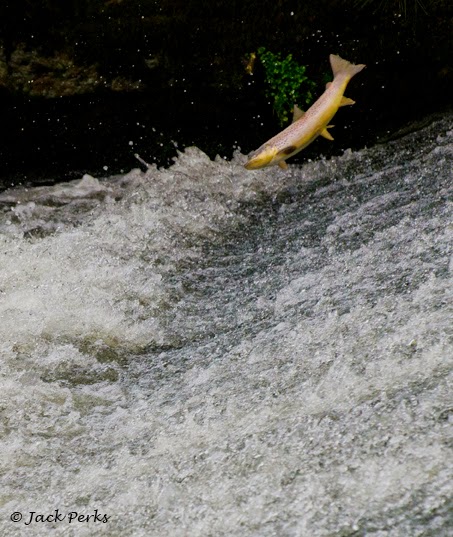
 Brown Trout leaping

I visited a fairly unknown site that has a steady run of Salmon as well as Brown Trout trying to get upstream. The Brownies would jump much higher then the Salmon but didn't have the strength to make it over the weir.

 Another unsuccessful leap

Brown Trout will jump to reach spawning grounds upstream with the Salmon and in some cases can hybridise with Atlantic Salmon though this is rare. It averaged 3 or 4 fish leaping a minute and although I've seen it on Autumnwatch every year nothing prepares you the actual site which put a smile on my face which would not dissipate.

 The mystery fish

At the time I thought this was quite a silvery fish to be jumping and wasn't till I got home that I realised it was a steelhead a searun rainbow trout which is a unusual fish for a river. Rainbows often find there way into rivers when they get washed in from fishing lakes or can be stocked by anglers but the anadromous form of the rainbow is a rarity in the UK.

Powering upstream


Brown Trout on its way to spawning grounds

Some of the fish almost look like they are taking flight and can really reach a good bit of height some going well over 6ft in the air. The remarkable journey these fish take is extraordinary with them growing up in the river and moving out to sea to feed up on shrimps and small fish before coming back from the northern atlantic ocean to spawn again.

Breaching the water the male has developed its pointed snout

Salmon in Scottish and Northern rivers can take up to 3 years to go back to sea while salmon in southern chalk streams will go after just one year because the warmth and extra food. Chalk stream salmon are under threat because they are at there temperature barrier for spawning so if the rivers increase in temperature they may disappear from them for good.
Hen salmon flung high into the air after leaping out of the rapids


Cock salmon making the leap

The sight of a huge Atlantic salmon breaching the rapids to go further upstream was something that will stick with me for a long time and always a nice change not squeezing into a wetsuit and having to get in a freezing river to photograph fish so i could get used to this kind of fish twitching!


BBC Wildlife Local Patch Reporter
Jack Perks

@JackPerksPhoto
Facebook: Jack Perks Photography
Website: www.jackperksphotography.com

Tuesday, 22 April 2014

Kingfisher: The Blue Flash


So this week I'm on my local patch looking for something above water for a change (shock horror!), the Kingfisher. I've never really been into birding but theirs just something about that electric blue flashing by that has always fascinated me with kingfishers. 


Rather then go with a long lens to start with i opted for a wide angle lens with a remote trigger and this was my first shot. Not my favourite image but a start, out of shot I'm hiding in the bushes with netting all over me.


I then changed to a 50mm lens so by no means a long lens but just to see how that looks with the kingfisher which again i quite liked. They quickly got used to the camera and the shutter going off and enabled me to get some more unusual images.


I switched to a more traditional long lens in the end but still tried to add elements of its environment into the images. Kingfishers with a black beak tend to be males while females have a bit of orange on them. the line down a kingfishers back also indicates age the shorter it being the older the bird.

Short Video of them

BBC Wildlife Local Patch Reporter
Jack Perks

@JackPerksPhoto
Facebook: Jack Perks Photography
Website: www.jackperksphotography.com

Friday, 31 January 2014

Welcome To My Patch

Myself snorkeling for zander


So firstly let me introduce myself, my name is Jack Perks a Nottingham based wildlife photographer covering all wildlife but a special interest in our freshwater species, which often leads me into underwater photography. I've always had interest in nature long before photography came into my life and I’ve been lucky for the most part of my life living in the local area and exploring parts people often over look.

Map of the area i'm mainly be sticking to


Here’s the area I’m focusing on part of the Trent Valley on the Nottinghamshire/Derbyshire boarder and the three main water courses that I’ll be exploring will be Fairham Brook, Nottingham Canal & The River Trent all very different waterways with unique wildlife as well as finding wildlife closer to home in my own garden. Fairham Brook is a small stream, which despite its urban location holds an amazing amount of wildlife. Nottingham Canal is still in use mainly for pleasure boats and siting’s of kingfisher are not uncommon, Finally the mighty River Trent the third largest river in the country, home to over 30 species of fish and recently otter siting’s something I’ll be chasing up.


European Eels can be found thoughout the River Trent

I’ll be covering a different species each week and describing ways I’ve photographed it as well as some taxonomy of the subject.

J


Wednesday, 15 February 2012

Nottingham Shoot: Day Four

I started the morning looking for small freshwater fish mainly stone loach and the rarer cousin the spined loach a fish you can only find in the east of england. the loach were proving very elusive however a few Bullheads, Minnows and Sticklebacks did show up giving me something to photograph.
Bullhead

Where Fairham brook meets the River Trent a prime habitat for many species of fish.


i then went out after the kingfisher once again but before i could put the Gopro on the branch but he beat me to it an was already there. I waited for him to leave and attached it but he did not return and this was as close as i got to him.


Tomorrow i have a bit of a dilema to either carry on with the kingfisher or go to a different site for other species not sure at the moment!

Hints -
Know you location i now know where the kingfisher lands and where he is most likely to feed this is a big help when im trying to photograph him

Sunday, 12 February 2012

Nottingham Shoot: Day one

Kingfishers & Grebes

as part of the freshwater fish project im also looking at there predators and with the shear abundance of wetland predators near my home i traveled from Cornwall to Nottingham. I got shots first at Fairham Brook a 2 minute walk from my house its has a pair of kingfishers i know well. i put a perch up and sure enough they went on it straight away however once they spotted me were straight of so later in the week i'll do a early shoot and wait in a hide for them. Mallards were feeding in the snow around me while i waited.

                                                             Female Mallard in snow

                              Shame about the twigs over him but good to see him out and about

Afterwards i turned my attention to another fish eating river bird, Great crested grebes. They quite abundant in Nottingham and are in most lakes, rivers and canals here. I chose to get shots along the West Bridgeford stretch of the River Trent as it has a regular pathway so the grebes are quite used to people and enabled me to use a 300mm to get shots. I think a bit closer to them would of worked better like a 500mm or longer but they did come close.

                                                       a hint of the snowfall from last week
                            Rain can really enhance a image so dont be discourage to go out in it


Hints - 
- Go out in the rain can be very rewarding
- Be patient and persistant 
- Know your location and what is going to be there