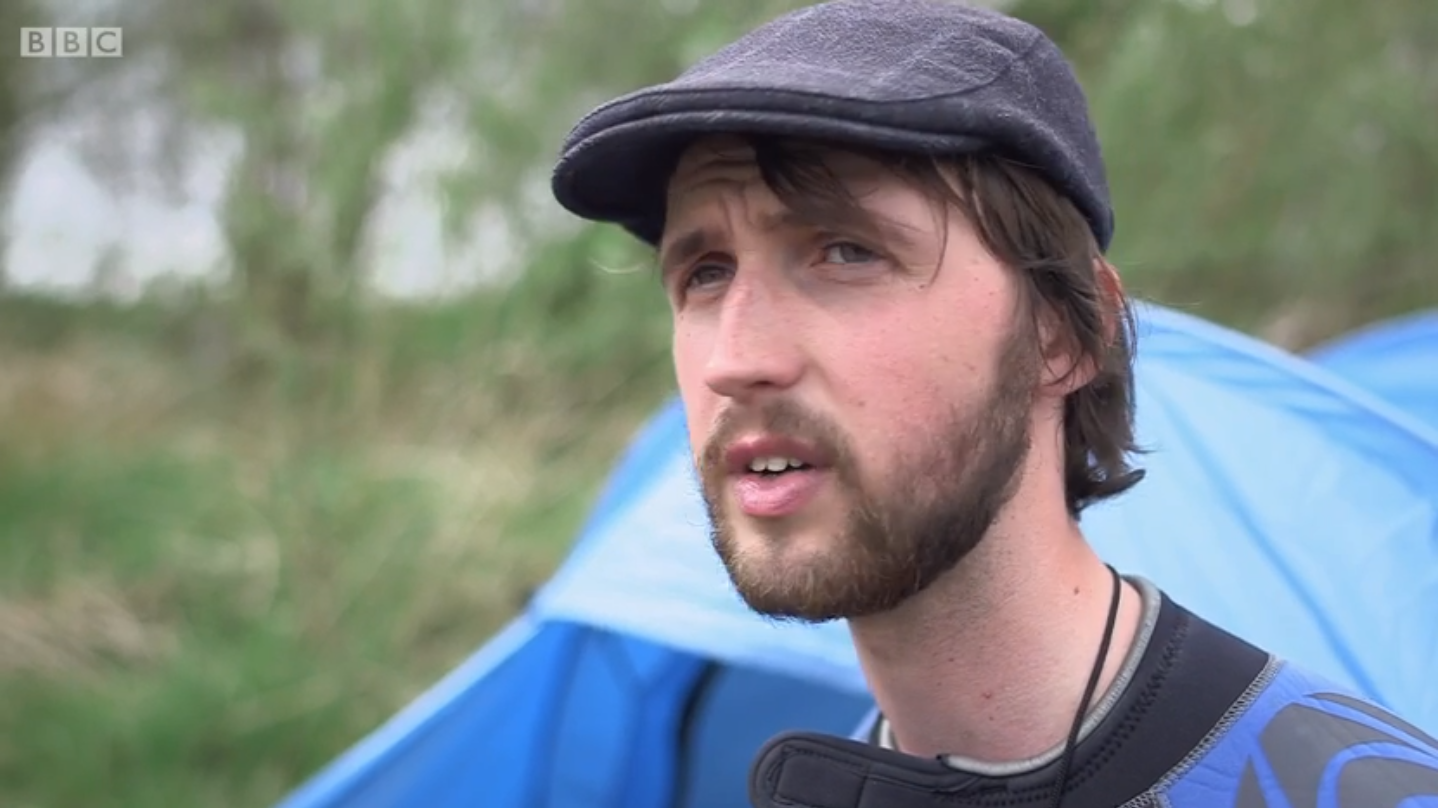
The tent used while being filmed for Springwatch in the Wye Valley in Wales
Its incredibly important to be comfortable when out taking images of wildlife as your much more likely to stay in the field if you warm and dry. When I under take shoot that require me to get up very early or not near roads I often camp to be on site for the action as it unfolds and this means using quality camping gear which I use mostly from Mountain Warehouse.
I feel a single tent is enough for most situations but a two man can be handy if you have lots of gear and like a bit of room. The tent has a ground sheet which keeps out the moisture and biting insects which when you may not be getting much sleep anyway from early starts makes all the difference. One of the main draws for me is that its very durable and lightweight so when trekking long distances it doesn't weigh me down.
View the tent on Mountain Warehouse
With the tent I then need a warm and waterproof sleeping bag. Even though I'll be careful and try to avoid getting moisture in the tent inevitably some will get in so a waterproof sleeping bag is a must. The Microlite 1400 has pockets inside so things like mobiles and wallets can be kept safe while sleeping. Its a great for use in cold temperatures up to -4c it will still keep you very warm and has a survival temperature of -21c! I the weather is mild its ideal for sleeping outside without a tent and gazing at the stars.
The shirt is a dull colour great for blending in with the environment and not being noticed by wildlife. The unique thing with this shirt is it has mosquito repellent built into it and with the long sleeves means that very few biting insects bother you (it wears of after 30 washes). Its also very breathable so in hot weather is a great choice but likewise for colder climbs not ideal. Its also very fast drying due to the mesh lining in the shirt.
To a degree walking boots are one of the most important things we as wildlife photographers need. Walking miles and miles often over rough terrain can take its toll on your feet so having hardy and comfortable shoes is a must have. I've been wearing these boots for about a month now in wetlands, grassland and mountainous areas and have no complaints about them even in shallow rivers they haven't let any water in and not caused any blisters or foot sores. They have a Iso grip which is ideal for icy or wet areas.
So after a month of waiting the piece I shot with Springwatch was finally shown and quite pleased how it turned out.
We filmed on the River Wye, Monmouthshire ideally hoping to film shad a stunning fish in the herring family that come into rivers to spawn. Though we were in the right place it was a bit early to see them however there was always a chance.
Minnows
We set up next to the river for the interviews and then I donned the classic combo of flatcap and wetsuit (I'm sure it will take off eventually) and dipped in to see what lurking in the depths. The water was quite clear but very fast so had to watch my foothold but soon enough saw huge shoals of minnows and lots of stone loach in the gravel.
My view from the other side of the interview with sound man Gary, cameraman Ralph and producer Bill
Shipping out the pole cam to film the fish
Sitting and watching what unravels
As well as me getting in I had left some static cams in areas I thought fish would swim by and it wasn't until the main show that I saw anything had come by which was nice to see Chub and Brown Trout investigating the camera.
Brown Trout
Stone Loach
Chub
Springwatch have in recent years definitely started to show off more of the little guys not just fish but inverts and herps to and it can only be a good thing to highlight them in a positive way, just look at the tremendous response spineless simon the stickleback has had off this years show!
I've spent a fantastic two weeks in the Cairngorms National Park the 1st week was revisiting old sites with friends while the 2nd week was my first tour as a photographic guide in the Cairngorms to 8 clients and co guide Josh Jaggard. I've been to CNP a few times now and seen a few species but wanted to go for some iconic highland species like crested tits, ptarmigan and black grouse.
Female Ptarmigan on a ski lek
My first target was a species I've never seen before the ptarmigan which is a member of the grouse family. Normally found higher up the the mountain ranges they blend in very well with the snow but in the spring time they stick out like a sore thumb making them easier to spot. I very surprised how calm they were around people and quite happy for me to crawl up to the them. This image is uncropped.
Male with female popping her head up
Despite the snow up cairngorm it can get very warm walking around the slopes
The grouse came a little to close to get the fighting shots a problem I wish I had with more species
Black grouse are something special and can be difficult to locate in there normal woodland habitat but in the spring they come out to lek, a breeding ritual to attract a mate and by using a hide you can get some fantastic images however theres a great deal of work involved.
I entered the hide at 5pm and stayed until 8:30am the next day sleeping in the hide so that I was there well before the lek began and in no way disturb the birds.
It was mainly the black grouse I was after however many species can be viewed like curlew, brown hare, roe deer, oyster catcher and this golden plover. Many waders come into the CNP to breed in the spring providing a interesting backdrop.
Hold territory on the moorland
The most common member of the grouse family in the cairngorms, red grouse are widely distributed in the moorland habitats of the park.
Crested Tit
The highlands are home to many species that are rare or not found anywhere else in the UK including the crested tit. Although they live in a range of habitats on the continent the Scottish subspecies is only found in scotch pine forests.
Scratchy enjoying a peanut
I don't tend name wildlife when I'm photographing but while watching numerous red squirrels it was easier to give them names to identify which ones were coming to the mound to feed, this one was very confident and we called him scratchy due to the marks on his side.
Common frog enjoying the sun
Now I know most people travel to the Cairngorms to focus on some of the more sexy species but I just love my little critters, amphibians being one of them and I was pleasantly surprised to find the cottages pond full of frogs! The start of the week it was frozen over and just a couple days later full of frogs!
Male waiting for some toad love
As well as the frogs I found some toads in a burn leading into a loch. Lots of thin males were waiting in the river for the females to return and pounce on them. The toads are so focused on breeding them are very easy to approach and with try and grab passing fish and even my camera thinking its a female toad and try to mate with it.
The clients on the second week
The second week was very enjoyable with the group and myself and Josh learned a great deal from the trip and looking forward to future trips.
Bonus Eider
On the visit home I convinced (begged) Josh to stop of in Northumberland to photograph the eiders one of my favourite birds. Ducks often look there best at this time of year just before them breed.
Now when most ask if they can stock fish into wildlife ponds they often get the answer 'No they will eat everything!' when really its not quite that simple. Fish are part of our heritage and deserve just as most protection as any other species so it just requires a bit of common sense when putting them into a wildlife pond whether its in your garden or a nature reserve. Which fish can go into ponds? Its all a matter of pond size, species and habitat. Crucians are nationally scarce and similar to scottish wild cats are being bred out by a similar species in this case the goldfish (ironically crucians are actually gold while goldfish are orange) They don't grow to huge sizes and mostly eat plant matter and small invertebrates so shouldn't upset my ponds ecosystem. I wouldn't stock fish into a pond smaller then a bathtub as a rule of thumb as they need space to move around. plenty of weed cover is good so the fish can evade predators themselves and the invertebrate life has a place to hide away. its perfectly healthy to have some predators in a pond to control numbers of species that would normally grow out of control. Other fish species that can do well in wildlife ponds are 9 spined sticklebacks which our smallest freshwater fish and often end up on the menu for many pond inverts like dragonfly larvae and diving beetles. like the crucian they are nationally scarce. For larger ponds tench, minnows and gudgeon can be great additions.
9 Spined Stickleback
Fish to avoid! despite there size 3 spined sticklebacks are incredibly aggressive little fish and will bite the fins off other fish in small spaces and quickly eat any small tadpoles or insect life (9 spines are much more placid hence better for wildlife ponds) Any predatory fish like pike, perch or trout are best avoid for small ponds and even species like rudd, roach and carp will quickly eat small species.
3 Spined Stickleback
Perch
Where to get the fish from? I wouldn't recommend taking fish from the wild as you could be introducing alien species into your pond and damaging wild stocks however there are plenty of fish farms and even garden centres now that sell native British fish for garden ponds. I'd recommend DC Freshwater Fish Suppliers
Fish Farm Tench
Anything I should do to the pond? Ponds don't need to be especially deep mine is about 1ft 1/2 at most and good for fish to dig into in the winter months and has lots of weed cover. I don't feed my fish but if wanted to top up there natural diet every now and then any pond fish food will be fine. I've had common frogs, toads and newts in my pond with the fish and the numbers have stayed the same.
My Wildlife Pond
So why have fish in my pond? Firstly its a different species to have that would never get into your naturally and if the water is clear enough great to watch swimming around. If your pond is on the larger size and has a good stock of fish you could attract birds like kingfishers which are unlikely to visit if the pond has no fish. Fish are fantastic in there own right and if you can help nationally rare species like 9 spines and crucians by stocking them then its got to be a good thing. BBC Wildlife Local Patch Reporter Jack Perks
For my last shoot of the year I decided to visit one of my favourite reserves and not to far away Attenborough Nature Reserve, a Nottinghamshire Wildlife Trust site it holds a stunning array of habitats most notably its wetland and reedbeds which would be the main focus for me today.
Reed Bunting
While in the kingfisher hide I noticed this little brown bird hoping around and visiting the feeder, I had no idea what it was (I'm afraid my bird knowledge still needs some work) later finding out it was a reed bunting.
Bittern in the reeds
I was delighted to see my first Nottinghamshire bittern after trying for the last couple of years of trying it was a true delight to see the little brown heron sunning himself. The tower hide is a little high up to get a decent shot of the bird but shows of the bird in any case.
Because of the cold weather often some of the smaller garden birds at Attenborough can become quite tame when encouraged with some food. On the way back to the car this robin was following me so having some seed on me I decided to give him a little feed when a idea for a shot came into me head!
Well 2014 is coming to a end and what a amazing year its been for me traveling all over the UK to document various species.
From these 10 trips alone I've traveled 3840 miles ! (from Nottingham and back)
Heres a rough recap of some of my best wildlife moments of 2014
10. Water Voles
In spring I visited the water voles in Derbyshire to try and build up a portfolio of images of them and is still something I'm working on now. 70% of voles dies during the winter and few live longer then a year so its a tough life for a vole not counting merciless mink or horrendous habitat destruction. One of my goals for 2015 is to film and photograph the voles underwater and have a couple of sites lined up for this.
9. Cornish Jelly
A trip I was looking forward to all year was returning to Cornwall to photograph Blue Sharks in Penzance however the weather was not on my side and due to high winds the boat trip was called off. Not wanting to waste a opportunity I snorkelled around the coastline at Falmouth and found this stunning Compass Jellyfish which had been washed in from the storms, it wasn't til after I discovered they are mildly venomous!
8. Richmond Park Deer Rut
Richmond is a national hotspot of the red deer rut and can often lead to legions of wildlife photographers visiting the park to photograph the clashing stags, while I was in the area talking to a local scuba club about underwater photography I decided to visit the park early to get some shots of the deer. They weren't quite rutting but very close to it with lots of chasing and parallel walking.
7. Leaping Salmon
When you think of Salmon you typically think of Scotland but I was pleasantly surprised to find a site less then a hour from my home! This population of salmon is the most inland group traveling up the Humber to reach the Dove in Derbyshire. BBC NEWS PIECE
6. Peak District
With the peaks being about a hour away I knew I wanted to do more work in the park this year, not just in rivers but more landscapes and wildlife also. The heather this august was breath taking and coupled with a sunrise it meant I even managed to get a half decent landscape shot.
5. White Clawed Crayfish
One of the great things with wildlife is it can always find a way to surprise you, while working for the Lincolnshire Rivers Trust they told me about a good population of white clawed crayfish in the River Witham a river I'd visited since a child but had no idea the crayfish were living in it. Within a few minutes of searching with a licensed surveyor we found 5 of them! With the crayfish plague wiping out a lot of them it was great to see a healthy population so close to were I live.
4. Powan of Loch Lomond
I suspect a lot of you reading this would of never of heard of a Powan or European Whitefish, its a rare glacial fish similar to arctic charr that are a left over from the last ice age. Due to climate change, invasive species and siltation the Powan have had a bit of a ruffe time. Normally they live deep down in the Lochs but visited some captive reared Powan at SCENE which are being studied and released back into the loch.
3. French Adventure
While filming for angling series 'Mr Crabtree goes fishing' I was tasked with underwater, time lapse, stills, some interviews and wildlife and I have to say France was a herpetologists dream! Reptiles are a big love of mine and saw whip snakes, viperine water snake, wall lizards and this stunning green lizard having a yawn.
2. Sea Lamprey
These really are a weird looking 'fish' I knew I wanted to photograph one of these fish for a while but they only enter rivers in early summer and even then only hang around for a few days so was a spur of the moment sort of thing when I heard they were around. I had a farmer in Sussex, wildlife trust member in Wales and river keeper in Hampshire looking for them and ultimately the river keeper got in touch first!
1. Puffins Underwater
I'm not overly a birder but have a great interest in all natural history particularly some of the iconic species like kingfisher, bittern and in this case the puffin. I did some research into areas to get underwater footage of puffins and the farnes was top of my list. I can tell you it was incredibly hard and didn't manage any high quality stills just footage on the GoPro (see below) but was amazing to see a species like this flying underwater and something I'll be working on next year for sure along with other water birds.
Donna nook was one of the places I've heard about for a while but never visited until recently and was a incredible experience seeing grey seal pups with in metres of me (behind a fence)
Less then a day old male pup with umbilical cord
The grey seal mums feed their pups for 15 to 21 days with a rich milk that is 60% fat and the grey seal pups balloon out very quickly. After this weaning stage the grey seal mums leave their pups and the area. Grey seal pups leave too, as they must teach themselves to feed.
Sleeping Grey Seal Pup
The scientific name of the grey seal,Halichoerus grypus, comes from the Greek for 'hooked-nose sea-pig'.
Grey Seal pups have a white coat when born & for up to 3 weeks, then they moult into their adult coat.
One draw back for me is the huge numbers of people which made the viewing slightly less pleasant but on the whole was worth a visit for sure.
Life is hard for Grey Seal pups. About 30 to 50 percent of them die before their first birthday. Grey seal mums recognise their own pups calls and know exactly how their own pup smells.
Although typically diving to depths of up to 70 metres when feeding, grey seals can dive to depths of around 300 metres.
Image taken through the fence not on open dunes and no contact with the seal was made